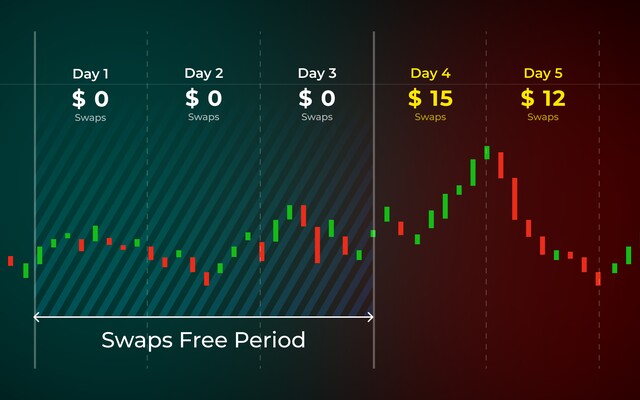
Swap-free accounts make sense as a product. They attract traders who need overnight positions without interest charges — Islamic finance compliance, promotional campaigns, retention programs. The problem is not the product. The problem is what happens when the time boundary disappears.
A swap-free account with no end date is not a promotional account. It is a permanent cost the broker absorbs on every rollover, indefinitely. In practice, tracking which accounts are swap-free, from when, and until when, is harder than it sounds — especially across large dealing operations where the status can drift without anyone noticing.

What the trigger does
The Swaps Free Accounts trigger gives dealers direct control over swap-free status. It can be applied to individual accounts or groups of accounts, with a defined start and end date. Alternatively, swap-free status can be set to apply only when a new position is opened — useful for promotional programs with a specific entry window rather than a fixed calendar period.
The result is swap-free conditions that are precisely time-bounded and easy to audit. No manual tracking, no status that quietly outlives its intended period.
Why this matters beyond the obvious
Without controls, swap-free status can become a source of quiet P&L leakage — especially in markets where adoption rates are high and accounts accumulate over time. A trader who holds large overnight positions on a swap-free account for months is exploiting a condition the broker intended as temporary. The trigger closes that window.
For a detailed breakdown of how swap-free conditions create structural risk when left unmanaged: swap-free isn't free: where exceptions become strategy.
The Swaps Free Accounts trigger is part of Brokerpilot's automatic controls suite.