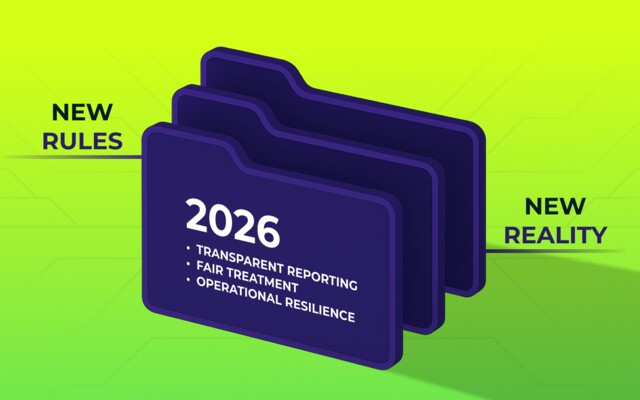
If 2023–2024 were about cleaning up marketing, and 2025 was about operational transparency, then 2026 is shaping up to be the year when regulators shift from "punish bad behavior" to "design the entire environment brokers operate in."
In simple terms: regulation used to tell brokers what NOT to do. Now it increasingly tells brokers HOW to run the business.
This isn't fearmongering. It's just where the global trend is going.
Across the EU, UK, Australia, UAE, South Africa, Singapore and even offshore jurisdictions, regulators are aligning — slowly, but noticeably — around the same areas: clarity of communication, reporting integrity, fairness controls, operational resilience, risk transparency, and the broker's internal "ability to explain."
Not because brokers are doing something wrong, but because retail participation is growing, and regulators want the playing field to stay predictable.
Let's break down what this means in human language — not legal language.
1. The Global Direction: Less About Leverage, More About Predictability
For almost a decade, the most dramatic regulatory topic was leverage caps. Now? Leverage isn't the main show.
European regulators continue to hold the ESMA standards. The UK keeps its own version. ASIC enforces its limits. Other major regulators follow similar patterns.
But the real shifts in 2025–2026 aren't about "1:30 or 1:500." They are about outcome testing, transparency of internal processes, consistency of treatment, audit trails, algorithmic decision explanations, timing integrity, and the client's "fair chance."
Translated into broker language: "Show your homework." Regulators don't just want the right result — they want proof that the result wasn't produced randomly. For a broader look at how these shifts affect broker operations, see: 2026 outlook for retail brokers.
2. The Big 2026 Focus: Reporting That Actually Matches Reality
A huge theme worldwide is the alignment between what brokers claim they do, what reports show, and what systems actually execute. Regulators now assume mismatches are unintentional — not malicious — but still unacceptable.
Execution timing reports
Even if your fills are fine, your record-keeping may not be.
Hedging disclosure accuracy
If you say "we hedge automatically," you must be able to show when, how, at what latency, and under what conditions. This is exactly what dealing operations monitoring is built to document.
Order routing logic clarity
If routing changes based on client type or risk profile, regulators want to see the logic and triggers.
Swap transparency
Not just what swaps are, but how they are generated, updated, and communicated. Swap-free account controls are increasingly under scrutiny in this context.
Policy-to-action alignment
If your client agreement says positions close at 50% margin level — they must close at 50%, not 48% or 53%.
Regulators don't demand perfect systems — they demand consistent systems. This trend will only intensify in 2026.
3. Marketing: The Era of Outcome-Based Oversight
One of the biggest shifts is happening in marketing compliance. It used to be about not promising unrealistic returns, not hiding risks, not misleading. Now regulators in multiple regions are looking at impact, not intent.
The new logic is simple: if a marketing message leads to confusion — it is a problem. If clients misunderstand a condition — it is a problem. If a campaign's effect differs from its wording — it is a problem.
Regulators are becoming "UX analysts." They look not just at text, but at placement, perceived meaning, behavioral effect, and the difference between what is written and what an average user hears. It is no longer enough to be technically correct. You have to be practically understood.
4. Operational Resilience Moves to Center Stage
Across jurisdictions, regulators are pushing toward stress testing, redundancy checks, failover planning, internal timing audits, crisis communication protocols, and business continuity procedures.
Operational resilience now includes:
How fast the broker can recover from outages
Seconds matter, not hours. The ROI of reaction time is no longer just an internal metric — it's becoming a regulatory one.
How consistent client experience remains during load
"It works most days" is no longer enough.
How predictable system responses are during stress
Rules must operate the same way on good days and bad days.
Whether the broker can explain anomalies
Not just "it was volatility," but "this rule fired at X, because Y changed at Z." This is where automated risk management with full audit trails becomes a compliance asset, not just an operational one.
Regulators want brokers to behave less like simple web platforms and more like financial utilities.
5. The Unexpected Risk Theme of 2026: Internal Coordination
This may be the least discussed but most impactful regulatory demand: alignment inside the company.
Regulators increasingly ask whether risk knows what marketing launched, compliance knows what sales promised, dealing knows what product changed, tech knows what compliance requires, and reporting matches actual execution.
A broker can have flawless systems and still break rules because teams don't share information. Regulators are no longer satisfied with "we have policies." They now check: "do your people follow them consistently?"
6. Regional Highlights (In Simple Terms)
Europe
- More fines for unclear disclosures,
- increased scrutiny on bonus structures,
- client classification under the microscope,
- ongoing reporting standardization,
- pressure on timing integrity and recordkeeping,
- transparency in swaps and pricing sources.
United Kingdom
- Strong stance on marketing language,
- higher expectations for business continuity,
- more pressure on senior manager accountability,
- closer oversight of overseas entities,
- data-driven enforcement and outcome analysis.
Australia
- Strict monitoring of CFD distribution,
- enforcement on retail investor protection,
- focus on misconduct reporting,
- heavy penalties for operational weaknesses.
Singapore
- Strong oversight of margin and leverage communication,
- high AML and CFT expectations,
- focus on management fitness and propriety,
- advanced reporting and control requirements.
UAE and other emerging hubs
- Push for more transparency in OTC products,
- clearer rules for marketing to non-qualified investors,
- higher demands on reporting and internal controls.
For a detailed look at the MENA regulatory environment specifically, see: MENA broker regulation and risk controls.
Offshore jurisdictions
- Movement toward baseline transparency standards,
- more structured licensing frameworks,
- minimum client protection expectations.
The global message is the same across regions: be clear, be consistent, and be able to prove it.
7. What Brokers Should Do in 2026 — A Practical Checklist
- Rewrite explanations in simple language — if a client needs a dictionary to understand a rule, the rule will cause trouble.
- Build consistency across departments — marketing, risk, compliance, support and product should describe the same thing in the same way.
- Strengthen reporting pipelines — make sure internal reports, regulatory reports and real system behavior actually match.
- Prepare an "explainability kit" — be ready to show why a system behaved a certain way at a certain time.
- Review swap and rollover transparency — clarify how, when and why swaps are applied or change.
- Validate operational resilience — test outages and failovers instead of assuming they will work.
- Keep public statements conservative — if there is a realistic risk of misinterpretation, adjust the wording.
- Know your jurisdictions — the gap between strict and "light" regimes is narrowing.
- Invest in internal coordination — one misunderstanding between departments can cost more than a market spike.
- Document everything — logs, timelines and decision trails make audits easier and cheaper.
Final Thought
2026 is not the year of fear. It is the year of clarity.
Regulators are not trying to make life difficult — they are trying to make it predictable. And predictable environments are good for brokers too. The more consistent the landscape becomes, the more room brokers have to compete on product quality, client experience, automation, risk sophistication and operational excellence.
The firms that embrace this shift early will thrive. The firms that resist it will spend 2026 chasing compliance fires.
Clarity wins. Consistency wins. And 2026 will reward the brokers who understand that.
Want to see how BrokerPilot helps brokers stay audit-ready and operationally resilient? Book a Presentation.
FAQ
What are the main regulatory trends for retail brokers in 2026?
The focus has shifted from leverage caps to operational transparency: reporting accuracy, audit trails, consistency between policies and system behavior, marketing outcome testing, and internal coordination. Regulators across ESMA, FCA, ASIC, MAS, and DFSA are converging around the same expectations — be clear, be consistent, and be able to prove it.
What does "operational resilience" mean in broker regulation?
Operational resilience refers to a broker's ability to maintain consistent, predictable operations during stress — outages, volatility spikes, liquidity disruptions. Regulators now expect brokers to document recovery times, test failover procedures, and prove that risk rules operate identically on good days and bad days.
How are swap and rollover practices being regulated?
Regulators are increasingly scrutinizing how swaps are generated, updated, communicated to clients, and applied consistently. Swap-free account management is a particular focus — especially in MENA and other Islamic finance markets — where timing mismatches and inconsistent classification create both compliance and P&L risk.
What does "explainability" mean for broker risk systems?
Explainability means being able to show exactly why a risk control fired at a specific moment — not just that it fired. Regulators want to see logs, decision trails, and timestamps that prove system behavior was consistent and rule-based, not arbitrary. This is why audit trails in automated risk management are becoming a compliance requirement, not just an operational convenience.
Which jurisdictions have the strictest broker regulations in 2026?
Europe (ESMA), the UK (FCA), and Australia (ASIC) remain the strictest. Singapore (MAS) maintains high standards particularly around AML and reporting. The UAE (DFSA/FSRA) is rapidly tightening transparency requirements for OTC products. Even traditionally lighter offshore jurisdictions are moving toward baseline client protection standards.